
Strategic Technical Analysis: Stoneware Bakeware Procurement in the United Arab Emirates Market
The hospitality and culinary retail landscape across the United Arab Emirates—anchored by luxury hotspots in Dubai, Abu Dhabi, and Sharjah—is undergoing unprecedented expansion. Driven by the Dubai Economic Agenda (D33) and the continuous influx of international Michelin-starred dining concepts, the structural demand for ultra-durable, thermally stable, and aesthetically distinctive commercial bakeware has reached a historic peak. For procurement directors, hotel purchasing groups, and houseware brand owners, sourcing stoneware bakeware requires an intimate understanding of ceramic material science, local food contact regulations, and regional operational stressors.
1. Material Science: Stoneware vs. Porcelain & Earthenware in High-Heat Applications
When evaluating ceramic bakeware for the UAE market, technical specifiers must distinguish between low-fired earthenware, traditional porcelain, and high-fired stoneware. Stoneware occupies a unique metallurgical-like position in ceramics: it is fired at temperatures ranging between 1200°C and 1280°C, causing the raw clay minerals (kaolin, ball clay, feldspar, and silica) to undergo complete vitrification.
Unlike earthenware, which remains porous and prone to absorbing moisture, oil, and bacteria, high-fired stoneware possesses a water absorption rate under 0.5%. Compared to porcelain—which can be brittle under mechanical impact—stoneware features superior wall thickness and flexural strength, making it less susceptible to rim chipping in fast-paced commercial dishwashing environments typical of Dubai’s high-volume catering sectors.
| Technical Metric | High-Fired Stoneware (ARTWAY Standard) | Commercial Porcelain | Standard Earthenware |
|---|---|---|---|
| Firing Temperature | 1220°C – 1280°C | 1300°C – 1400°C | 900°C – 1050°C |
| Water Absorption | < 0.5% (Vitreous) | < 0.1% (Vitreous) | 3.0% – 10.0% (Porous) |
| Thermal Shock Tolerance (ΔT) | Up to 220°C – 250°C | Up to 180°C – 200°C | < 140°C (High Risk) |
| Mechanical Impact Resistance | High (Dense, thick-walled geometry) | Moderate (Brittle on sharp edges) | Low (Easily chipped) |
| Glaze Abrasion Resistance | Mohs Hardness 6.5 – 7.0 | Mohs Hardness 7.0 | Mohs Hardness 4.0 – 5.0 |
| Food Contact Safety | Lead/Cadmium Free (ISO 6486-1) | Lead/Cadmium Free | Requires Heavy Testing |
2. Localized Application Scenarios Across the UAE & GCC Foodservice Ecosystem
To maximize ROI, stoneware bakeware design must directly match the specific culinary protocols of the Middle Eastern market:
- Traditional Slow-Cooked Emirati & Khaleeji Cuisine: Dishes like Lamb Machboos, Kofta bi Tahini, and Harees demand prolonged, uniform oven baking. Stoneware’s exceptional thermal mass ensures heat is retained long after leaving the oven, keeping dishes hot during extended buffet presentations in luxury hotel banquets across Abu Dhabi and Dubai.
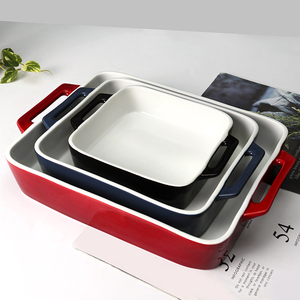
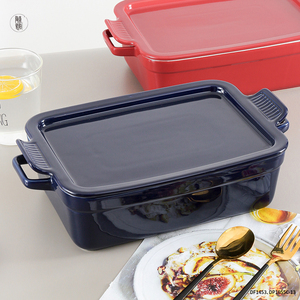
- High-Density Ramadan Catering Operations: During Iftar and Suhoor services, commercial kitchens process thousands of covers within narrow time windows. Stoneware casserole dishes with dual-reinforced handles allow service staff to transport heavy, hot dishes safely from kitchen to table.
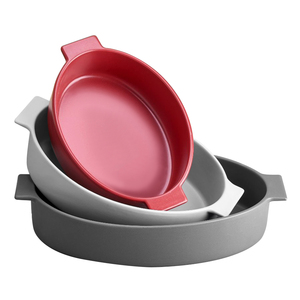
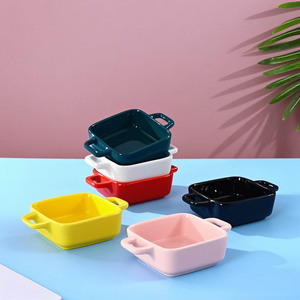
- Cloud Kitchens & Premium Food Delivery Brands: The UAE leads the region in dark kitchen density. High-end meal subscription services utilize compact, stackable stoneware baking dishes that fit standardized commercial delivery holding units without heat loss.
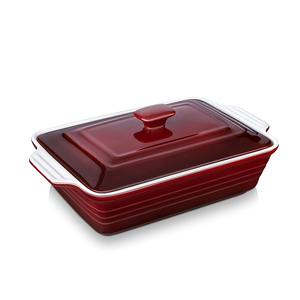
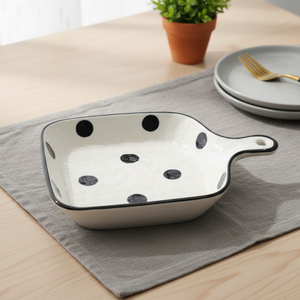
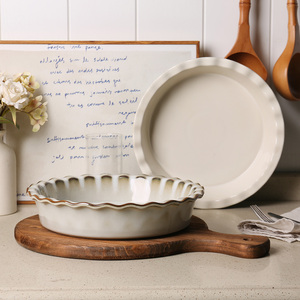
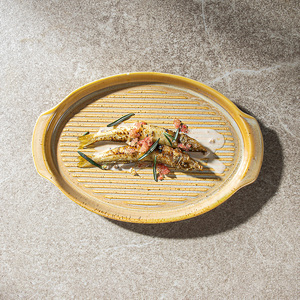
- Luxury Retail & Department Store Branding: Retail consumers in Dubai Mall or Mall of the Emirates demand modern aesthetic finishes—such as semi-matte glazes, speckle finishes, and organic earth tones—matching contemporary home kitchen aesthetics.
3. Regulatory Compliance: UAE MoIAT, ECAS & Food Contact Safety
Importing ceramic and stoneware products into the United Arab Emirates requires strict adherence to federal regulations overseen by the Ministry of Industry and Advanced Technology (MoIAT) under the Emirates Conformity Assessment Scheme (ECAS). Ceramic bakeware coming into contact with food must pass stringent heavy metal leaching tests:
Our manufacturing facility enforces rigorous quality control in accordance with ISO 6486-1:1999 standards. Raw glazes are regularly screened in certified laboratories to guarantee that lead leaching stays below 0.5 mg/L and cadmium below 0.05 mg/L. Full testing documentation and Certificates of Conformity (CoC) are issued for every export batch heading to Jebel Ali Port, ensuring seamless customs clearance without costly detention delays.
4. Strategic OEM Customization & Manufacturing Capabilities
Operating from our owned 10,000 m² factory established in 1993, ARTWAY provides full end-to-end OEM and private label production. Unlike trading companies that aggregate products from unverified third-party kilns, our integrated model guarantees:
- Custom Form & Ergonomics: Creation of bespoke shapes, integrated lid grooves, and specialized handle dimensions tailored for hotel operational ergonomics.
- Advanced Glaze Engineering: In-house formulation of reactive, matte, satin, and glossy glazes designed to resist cutlery scratch marks and chemical fading from harsh commercial detergents.
- Brand Integration: High-precision debossed logo stamps on the stoneware base or high-fire underglaze decals that will never wear off over thousands of washing cycles.
- Retail-Ready Packaging Solutions: Custom color boxes, drop-tested mail-order packaging for e-commerce brands, and reinforced bulk palletization built for ocean transit.