Engineered for thermal shock durability ($ΔT \ge 180^\circ\text{C}$), high vitrification, and commercial food-service reliability. Custom shapes, glazes, and private label execution.
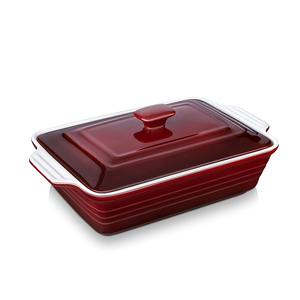
Commercial-grade vitrified stoneware body featuring uniform heat distribution and a fitted moisture-locking ceramic platter lid.
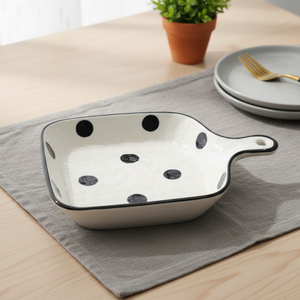
Modern aesthetic 9-inch baker engineered with reinforced dual side handles and scratch-resistant underglaze decoration.
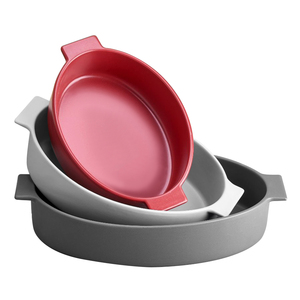
Architectural semi-matte glaze finish on a thick-walled au gratin dish. Superior thermal retention for fine dining serveware.
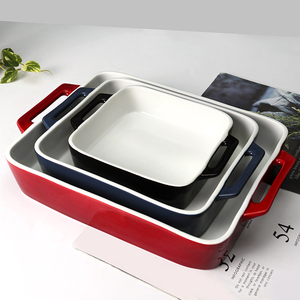
Multi-piece modular nesting bakeware set designed for space-saving e-commerce retail packaging and maximum freight efficiency.
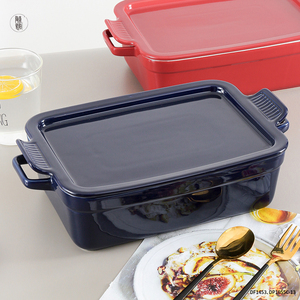
Dual-purpose stoneware baker featuring a multi-functional flat lid that doubles as a standalone roasting platter or trivet.
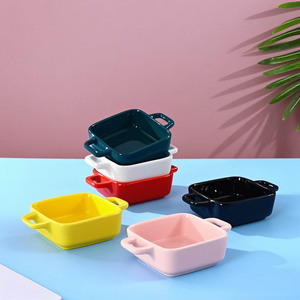
Vibrant color-glazed stoneware collection utilizing reactive glaze dipping techniques for artisan boutique homeware lines.
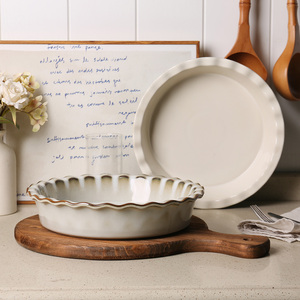
Cost-optimized bulk production baking tray series designed for high-volume department store retail promotional campaigns.
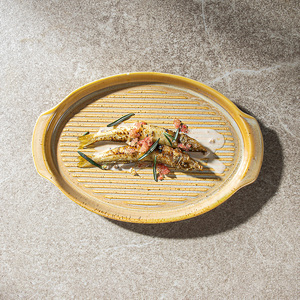
Hand-speckled artisan stoneware pasta baker built with vitrified ceramic body for commercial restaurant convection ovens.
The global ceramic bakeware supply chain is experiencing a structural migration toward high-fired stoneware (matured at 1250°C–1280°C firing schedules). Commercial buyers, volume importers, and department store procurement heads are increasingly prioritizing dense stoneware bodies over conventional earthenware and standard borosilicate glass due to stoneware’s unique mechanical strength, zero-porosity vitrification, and aesthetic versatility in oven-to-table dining applications.
When selecting a qualified stoneware bakeware supplier & exporter, procurement executives must evaluate underlying ceramic material properties. High-fired stoneware is distinguished by its mineral composition—primarily kaolin, ball clay, feldspar, and silica—which undergo complete phase transformation during high-temperature tunnel kiln firing. This creates a dense mullite crystalline structure inside the body, yielding superior flexural strength, thermal conductivity, and structural resilience.
To assist global buyers in technical vendor evaluation, the following comparison matrix details critical mechanical and physical performance parameters across primary ceramic and bakeware substrates:
| Evaluation Parameter | High-Fired Stoneware (ARTWAY Standard) | Commercial Earthenware | Porcelain Bakeware | Borosilicate Glass |
|---|---|---|---|---|
| Firing Temperature Range | 1250°C – 1280°C (Cone 8–10) | 1000°C – 1150°C | 1300°C – 1400°C | Melting ~ 1400°C |
| Water Absorption (ASTM C373) | < 0.5% (Vitrified) | 3.0% – 7.0% (Porous) | < 0.1% (Vitrified) | 0.0% (Non-porous) |
| Thermal Shock Resistance ($ΔT$) | 180°C to 220°C | 120°C to 140°C | 160°C to 180°C | 150°C to 180°C |
| Glaze Abrasion Resistance | Excellent (Mohs Hardness 6.5+) | Moderate (Scratches easily) | Superior (Mohs Hardness 7+) | Low (Etches over time) |
| Oven / Microwave / Freezer Safe | Yes (Certified) | Limited Thermal Tolerance | Yes | Yes (No Broiler) |
| Custom Aesthetic Capability | High (Reactive, Matte, Decals) | High (Low Temp Decals) | Moderate (Mostly White) | None (Transparent) |
Founded in 1993 in Samut Sakhon, Thailand, with a registered capital of 30 million THB, ARTWAY Company Limited stands as a premier direct-factory manufacturer and exporter of ceramic tableware, stoneware bakeware, and specialty lifestyle ceramics. Operating out of a fully integrated 10,000 square meter production facility powered by over 200 skilled ceramic artisans and technical engineers, ARTWAY produces over 5,000,000 ceramic pieces annually for major international retailers, hotel chains, and premium houseware brands across Europe, North America, Japan, Australia, and the Middle East.
Unlike trading intermediaries, ARTWAY manages the full ceramic lifecycle in-house—from raw material formulation, 3D mould development, and glaze laboratory chemical formulation, to high-temperature continuous kiln firing, strict AQL quality control, and export-compliant retail packaging.
Formulating 100% lead-free and cadmium-free glazes compliant with FDA 21 CFR 175.300, California Proposition 65, and EU Directive 84/500/EEC.
Rapid plaster casting, CNC model carving, and prototype development within 15–25 working days from approved technical CAD drawings.
Exporting directly from Samut Sakhon (near Bangkok & Laem Chabang ports), enabling global buyers to bypass punitive anti-dumping duties.
As global consumer expectations shift toward healthy living, eco-conscious kitchenware, and multifunctional home aesthetics, international procurement directors must align their product development programs with five strategic industry trends:
Standard white porcelain is increasingly yielding market share to rich, tactile reactive glazes. Through controlled chemical crystallization inside high-temperature gas kilns, reactive glazes create individual color variations on every pan—giving mass-produced retail bakeware a handcrafted, artisanal studio pottery appearance favored by millennial and Gen-Z consumers.
Modern commercial bakeware design incorporates engineered structural ribbing along bottom bases and handle sidewalls. This geometric enhancement optimizes heat absorption vectors during convection baking while distributing thermal expansion stress evenly, significantly minimizing micro-cracking when transferring directly from a 200°C oven to ambient countertop temperatures.
With direct-to-consumer (D2C) online retail expansion, standard master carton bulk packaging is no longer sufficient. Leading stoneware suppliers now offer pre-tested, drop-ship compliant mail-order packaging (complying with ISTA 6-Amazon.com-Overboxing standards) featuring molded EPE foam, reinforced honeycomb corner protectors, and 5-ply corrugated outer boxes to eliminate transit damage.
Environmental governance (ESG) regulations require factories to minimize landfill footprint. Advanced stoneware operations utilize closed-loop water filtration units and recycle 100% of unfired clay scraps (greenware trimmings) back into the slip preparation phase, significantly reducing raw material extraction impact.
To maintain zero-defect standards across multi-container production runs, ARTWAY enforces a rigorous 5-stage Quality Assurance Gate System throughout the manufacturing sequence:
Silica and kaolin minerals are wet-milled in ball mills to achieve a particle fineness of 325 mesh. Electromagnetic iron separators remove trace metallic impurities to prevent dark spots during firing.
Utilizing automated jiggering machines for symmetrical round pans and pressure slip-casting for complex rectangular casserole dishes with integrated handles, maintaining tight wall-thickness tolerances (± 1.5mm).
Computer-controlled robotic spraying and manual dipping ensure uniform glaze coat thickness (0.4mm–0.6mm). Custom logo backstamps are applied using high-fire silk-screen ceramic decals.
Ware travels through a 80-meter continuous tunnel kiln over a 14-hour firing cycle, reaching peak temperature at 1260°C to achieve full vitrification and complete glaze fusion.
Random batch samples undergo thermal shock testing (200°C oven to 20°C water bath), microwave spark testing, dishwasher glaze abrasion testing, and AQL Level II sampling inspection prior to container packing.
Key technical, commercial, and operational questions answered directly by ARTWAY's senior ceramic export engineering team: