Precision-engineered ceramic non-stick pots, pans, and Dutch ovens manufactured under international quality standards (FDA, LFGB, REACH certified).
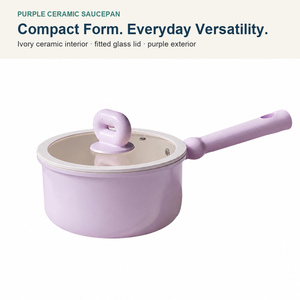
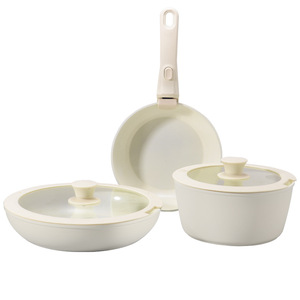
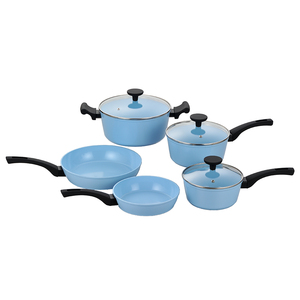
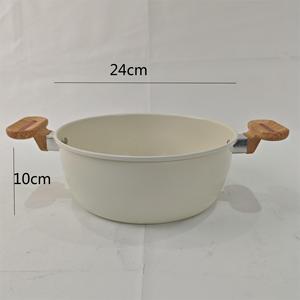
The global culinary hardware and kitchenware market is undergoing a seismic paradigm shift. Driven by tightening regulatory mandates across North America and the European Union—specifically regarding PFAS, PFOA, PFOS, and heavy metal restrictions—procurement teams, high-end retail buyers, and private label importers are aggressively transitioning away from legacy PTFE (Teflon) coatings toward advanced ceramic non-stick solutions. Selecting a premier custom OEM ceramic cookware manufacturer has become a vital strategic objective for kitchenware brands seeking to safeguard market share, meet consumer eco-wellness demands, and insulate supply chains against evolving chemical compliance bans.
Modern ceramic non-stick cookware is no longer a niche, delicate eco-alternative. Through breakthroughs in inorganic sol-gel chemistry, sub-micron silica matrix reinforcement, and high-temperature curing cycles, contract manufacturers can now deliver cookware lines that offer exceptional scratch resistance, superior abrasion endurance, dynamic induction compatibility, and brilliant color fastness. This comprehensive technical whitepaper delivers the quantitative data, engineering frameworks, and procurement insights necessary for professional buyers to evaluate OEM partners, optimize tooling investments, and execute seamless mass manufacturing projects.
Supply Chain Insights (2025–2030): Market intelligence predicts a CAGR of 7.8% for inorganic ceramic-coated kitchenware, significantly outstripping traditional fluoropolymer cookware growth. Sourcing directors who establish direct OEM contracts with fully integrated factories gain significant margin control, exclusive glaze customization, and robust regulatory compliance documentation.
Understanding the underlying material science is paramount when auditing a potential custom OEM ceramic cookware manufacturer. Unlike organic fluoropolymer coatings applied via liquid spray suspension and baked at moderate temperatures, true ceramic non-stick coatings are derived from sol-gel chemistry.
The sol-gel process involves transforming liquid chemical solutions (sols) into an integrated gel network composed of inorganic polymers. The primary precursor material is silicon dioxide (SiO2), often combined with titanium dioxide (TiO2) or zirconium dioxide (ZrO2) to elevate mechanical hardness and heat distribution performance.
Completely free of PTFE, PFOA, PFOS, Cadmium, and Lead. Does not emit toxic fumes or breakdown vapors even when dry-heated up to 450°C (842°F).
Sol-gel inorganic matrices maintain structural bonding integrity under intense thermal cycling, eliminating blistering, micro-crazing, and delamination.
Achieves a Pencil Hardness rating of 9H or greater, offering superior resistance to metal utensil abrasion compared to standard non-stick surfaces.
The structural performance of ceramic cookware relies heavily on the substrate material and the preparation of the bonding surface. OEM clients can select from three primary core materials depending on market positioning, weight targets, and heat retention requirements:
| Substrate Core Type | Manufacturing Process | Thermal Distribution | Key OEM Advantage | Target Retail Segment |
|---|---|---|---|---|
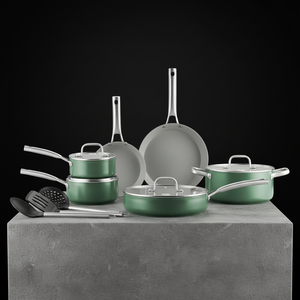
| Die-Cast Aluminum | High-pressure precision liquid casting | Exceptional, even distribution without hot spots | Allows variable wall thickness (thick base, thin rim) | Premium Modern Retail & E-Commerce |
| Forged / Heavy Gauge Aluminum | Mechanical stamp forging under extreme force | Rapid heating speed, light-to-medium weight | Cost-effective mass tooling with high structural yield | High-Volume Department Stores |
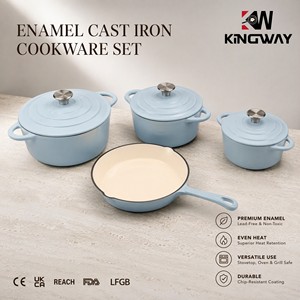
| Enameled Cast Iron | Molten iron casting into sand molds | Extreme heat storage & slow thermal release | Lifetime durability; ideal for Dutch ovens & braisers | Luxury Culinary & Professional Chef Lines |
| High-Fired Stoneware Ceramic | Slip casting & jiggering fired at 1250°C+ | Gentle, uniform baking cycle | Oven-to-table aesthetic; 100% metal-free body | Boutique Lifestyle & Bakeware Brands |
To maintain a competitive edge, procurement officers must align with manufacturers capable of integrating forward-looking technological advancements. As a leading specialized custom OEM ceramic cookware manufacturer, our R&D facility prioritizes five disruptive technical trends shaping the global supply chain:
Unlike trading intermediaries or fragmented assembly plants, our manufacturing campus combines in-house mold tooling workshops, computerized glaze mixing laboratories, automated robotic spray lines, and continuous tunnel kilns under one central management structure. Established in 1993 with decades of stoneware and ceramic substrate mastery, our engineering protocols eliminate color tone variations across production batches, guarantee strict dimensional tolerances, and provide direct factory-floor cost savings.
A reputable OEM supplier must substantiate product quality with rigorous, verifiable laboratory testing. Every batch of custom ceramic cookware produced undergoes a comprehensive matrix of quality assurance evaluations prior to bulk container loading:
Pans are heated uniformly to 250°C (482°F) and immediately submerged into 15°C cold water. This cycle is repeated 30 consecutive times to verify that the ceramic coating substrate interface does not undergo micro-cracking, crazing, or loss of adhesion due to differential thermal expansion.
Utilizing mechanized oscillating pad abrasive test equipment under constant downward pressure (500g load), coatings must endure a minimum of 10,000 to 20,000 continuous stroke cycles while maintaining hydrophobic surface tension (water contact angle > 100°).
Simulated food acid leaching tests (4% acetic acid solution boiled for 2 hours) are conducted on all custom glazes to ensure absolute zero leaching of Heavy Metals (Lead, Cadmium, Arsenic, Antimony) and complete compliance with US FDA 21 CFR 175.300, EU Framework Regulation (EC) No 1935/2004, and German LFGB Section 30 & 31.
A precision multi-blade cutter creates a 10x10 lattice grid on the cured ceramic surface. Standard pressure-sensitive adhesive tape is applied firmly and snapped off at a 90° angle. A passing score requires Grade 5B (0% flaking or detachment of lattice squares).
Our baseline OEM minimum order quantity starts at 500 to 1,000 sets per colorway/shape for standard aluminum cores, and 300 to 500 sets for custom enameled cast iron lines. For custom brand-new 3D body shapes requiring dedicated mold fabrication, we offer flexible volume tiers to help brands scale initial product launches efficiently.
Initial 3D computer models and prototype renderings take 3–5 working days. Custom plaster or steel mold tooling fabrication requires 15–20 days. Once rapid prototype samples are approved by your product team, standard mass production lead time is 35–45 days depending on glaze complexity and order quantity.
Yes. Our inorganic ceramic coatings are high-temperature cured (380°C to 450°C), making them inherently heat resistant and oven-safe up to 400°C (752°F), far exceeding PTFE limits. While machine dishwashing is safe due to high chemical alkali resistance, hand washing is recommended for all non-stick cookware to maximize surface non-stick longevity.
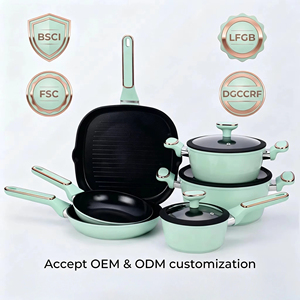
Absolute customization is our core strength. We can match any specific Pantone (PMS) hue for both inner ceramic coatings and outer heat-resistant lacquer finishes. Furthermore, we offer custom laser-etched stainless steel base logos, branded bottom backstamps, custom silicone handles, and mail-order drop-test certified gift box packaging (ISTA 3A compliant).
We manage complete FOB, CIF, or DDP export workflows. Shipments leave via major deep-water ports (such as Bangkok or Laem Chabang), accompanied by full Bill of Lading documentation, Certificate of Origin (Form E/Form A), HS Code classification guidance (HS 7615.10 / HS 7323.91), and verified lab test reports ready for customs clearance in the US, EU, UK, Australia, and Japan.
Partner with a proven manufacturer capable of turning technical drawings into market-ready, non-toxic cookware sets. Contact our engineering and export team today to receive a free DFM (Design for Manufacturing) review and quotation.