0%

Choosing reliable Stoneware Baking Dish Wholesale suppliers in China requires more than comparing product photos and quoted prices. Professional buyers must examine clay composition, glaze consistency, heat resistance, packaging strength, and production capacity. A dish may look attractive online, yet develop hairline cracks after repeated oven use. That detail matters.

This guide introduces ten Chinese suppliers serving importers, retailers, restaurants, and private-label brands. The selection considers manufacturing experience, export communication, quality-control procedures, customization options, and buyer feedback. Factory audits and sample testing remain essential. No supplier list is perfect.

Each company should be assessed against your actual purchasing needs. Ask about stoneware firing temperatures, food-contact compliance, lead and cadmium testing, carton design, and replacement policies. Request samples before confirming a large order. A small test shipment can reveal glaze pinholes, uneven bases, or weak dividers that photographs hide.

Pricing also deserves careful interpretation. A low factory quotation may exclude molds, inner boxes, inspections, inland transport, or protective packaging. Experienced sourcing teams calculate the complete landed cost. They also confirm whether the supplier communicates clearly when production problems occur. That response often shows more than a polished catalog.

Some rankings in this article may change as factories expand, certifications expire, or market performance shifts. Readers should verify current documents and production conditions independently. Still, this overview offers a practical starting point for finding capable Chinese stoneware baking dish manufacturers. The best partnership is not always the cheapest one. It is the one that delivers consistent products, honest communication, and dependable support across repeated orders.
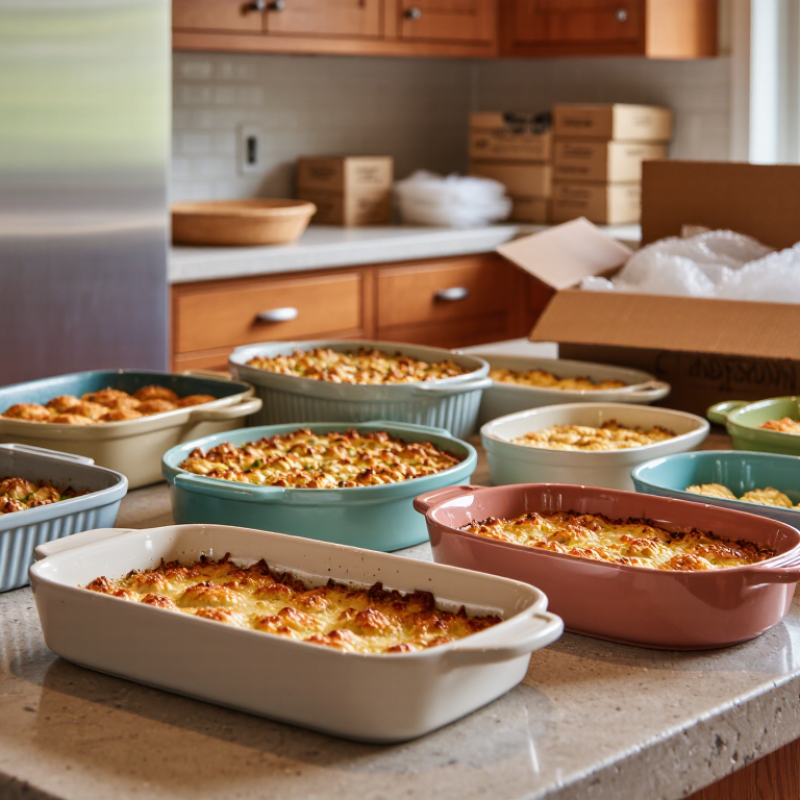
China Top 10 Stoneware Baking Dish Wholesale Suppliers?

What Makes Stoneware Baking Dishes Suitable for Wholesale

Stoneware baking dishes suit wholesale because they combine daily utility with a solid, premium feel. According to Grand View Research, the global bakeware market was valued at several billion U.S. dollars in recent reporting, with steady growth expected through 2030. This trend supports repeat demand from retailers, foodservice buyers, and home-cooking customers. Stoneware also retains heat well, helping baked pasta, pies, and casseroles stay warm at the table.

Durability matters more than appearance. Properly fired stoneware resists ordinary oven use, surface scratching, and repeated washing. However, thermal shock remains a real weakness. A hot dish placed on a cold stone surface may crack. That assumption needs checking. Wholesale buyers should request test results for heating cycles, glaze adhesion, water absorption, and impact resistance. The ASTM ceramic product standards offer useful reference points, while food-contact testing should verify lead and cadmium limits for the destination market.

Packaging can decide whether a good product becomes a costly return. Retail-ready cartons need molded protection around handles, corners, and lids. A 2023 report from Smithers on sustainable packaging also highlights rising pressure to reduce unnecessary packaging materials. Suppliers should therefore compare protection, carton size, and recyclable content instead of choosing the cheapest box. In my purchasing experience, small glaze variations are often acceptable, but unstable bases and uneven rims are not. Stoneware is strong, yet quality control cannot be treated as an afterthought.

How to Evaluate Chinese Stoneware Baking Dish Suppliers

When evaluating Chinese stoneware baking dish suppliers, start with evidence rather than attractive catalog photos. Ask for the factory address, production flow, clay source, firing temperature, and quality records. A reliable supplier should explain body composition, glaze application, and temperature limits clearly. Request recent samples in several sizes, including one with handles. Inspect the rim, base, glaze consistency, and packaging after delivery. Small defects often reveal larger process problems.

Use the samples in realistic tests. Heat an empty dish only when the supplier’s instructions permit it. Check for warping, crazing, stains, and handle weakness. Test repeated oven cycles and sudden temperature changes with a documented protocol. Do not rely on one sample. I once approved a smooth-looking piece before checking its base flatness. It rocked on a glass shelf. That mistake taught me to inspect function, not appearance alone.

Ask for food-contact test reports from qualified laboratories. Verify report numbers and product specifications. Confirm compliance for the destination market, labeling, packaging, and traceability. Documents can be outdated. This is easy to miss. Evaluate production capacity through a pilot order. Compare promised output with actual inspection results, lead times, carton strength, and defect rates. Discuss mold ownership, replacement parts, minimum order quantities, payment terms, and corrective action before signing. A professional supplier records complaints with photos, batch codes, and deadlines. Communication matters too. Slow replies may signal weak after-sales control, although time-zone delays can confuse the picture. Keep written records and revisit your criteria when the first shipment exposes assumptions.

China Top 10 Stoneware Baking Dish Wholesale Suppliers? - How to Evaluate Chinese Stoneware Baking Dish Suppliers

Anonymous supplier screening matrix based on practical wholesale evaluation criteria and commonly used food-contact standards.

Rank Anonymous Supplier Primary Evaluation Focus Typical Product Range Indicative MOQ Indicative Lead Time Temperature Capability to Verify Food-Contact Documentation Quality-Control Priority Recommended Verification Screening Score
1 Supplier A High-volume private-label production Rectangular, oval, and round stoneware baking dishes 1,000–3,000 pieces per design 35–55 days after approval Approximately −20°C to 220°C; confirm by test report FDA food-contact and EU food-contact documents requested Glaze consistency, warpage, rim chips, dimensional tolerance Pre-shipment inspection and thermal-shock testing 92/100
2 Supplier B Custom shapes and embossed designs Embossed casserole dishes and serving bakeware 800–2,000 pieces per design 40–60 days after mold approval Approximately −18°C to 230°C; verify product-specific limits EU Regulation 1935/2004 and lead/cadmium migration testing requested Mold accuracy, detail definition, glaze adhesion Approve a production sample before bulk manufacture 90/100
3 Supplier C Mid-size wholesale programs Standard rectangular and square baking dishes 500–1,500 pieces per design 30–50 days after order confirmation Approximately −20°C to 200°C; confirm with laboratory evidence Material declaration and migration test reports requested Body cracks, pinholes, glaze defects, packaging damage Factory audit and random carton inspection 87/100
4 Supplier D Retail-ready packaging and gift sets Baking dish sets with lids, sleeves, or gift boxes 1,000–2,500 sets 35–55 days, excluding packaging artwork approval Approximately −20°C to 220°C; confirm lid limitations separately Food-contact declaration, packaging material compliance, migration testing Drop resistance, barcode accuracy, set completeness Packaging drop test and carton packing inspection 85/100
5 Supplier E Small-batch and test-market orders Core shapes with standard glaze colors 300–800 pieces per design 25–45 days after sample approval Approximately −18°C to 200°C; product-specific verification required Request current test reports from an accredited laboratory Batch consistency and color repeatability Compare pre-production and mass-production samples 83/100
6 Supplier F Export-oriented compliance systems Stoneware bakeware for North American and European markets 1,000–3,000 pieces per design 40–60 days after technical confirmation Approximately −20°C to 230°C; require thermal-shock evidence ISO 9001 evidence, food-contact declarations, migration reports requested Traceability, test-report validity, corrective-action records Verify certificate scope, issuer, dates, and factory address 82/100
7 Supplier G Decorative and premium-finish collections Reactive-glaze, speckled, and textured stoneware dishes 800–2,000 pieces per design 40–65 days due to finish control Approximately −18°C to 220°C; confirm glaze performance Heavy-metal migration and food-contact surface testing requested Color variation, glaze pooling, surface roughness Define acceptable color and finish tolerance in writing 80/100
8 Supplier H Fast sampling and product development Prototype-based dishes and seasonal collections 500–1,500 pieces per design 7–15 days for samples; 30–50 days for production Confirm oven, freezer, microwave, and dishwasher suitability Request sample-specific food-contact test evidence Sample-to-bulk consistency and design ownership Use signed specifications and approved golden samples 78/100
9 Supplier I Cost-focused standard production Basic single-color baking dishes 1,500–5,000 pieces per design 30–50 days after order confirmation Confirm the exact maximum oven temperature before purchase Require valid lead/cadmium migration reports before shipment Wall thickness, flatness, breakage rate, carton protection Independent pre-shipment inspection using AQL sampling 75/100
10 Supplier J Flexible mixed-order sourcing Mixed sizes, colors, and catalog-style collections 300–1,000 pieces per SKU 35–60 days depending on SKU mix Verify each shape and glaze combination separately Request documentation for every food-contact surface and glaze SKU accuracy, color matching, assortment completeness Conduct carton-by-carton assortment and labeling checks 73/100
Evaluation note: MOQ, lead time, temperature capability, certification, and screening scores are indicative procurement benchmarks rather than company-specific claims. Confirm all specifications, test reports, certifications, factory details, and commercial terms directly with each supplier before placing an order.

Top 10 Stoneware Baking Dish Wholesale Suppliers in China

China’s top 10 stoneware baking dish wholesale suppliers should be judged by more than price. Reliable factories usually offer stable clay formulas, even glazing, and controlled kiln temperatures. Ask for samples before discussing large orders. Check the dish wall thickness, rim smoothness, color consistency, and resistance to thermal shock. A practical sample test includes baking, cooling, washing, and repeating the process several times. Small defects often appear after repeated use.

Experienced buyers should request food-contact test reports, production photos, packaging details, and clear product specifications. Confirm dimensions, capacity, minimum order quantity, lead time, and customization limits. Strong suppliers explain their inspection process instead of giving vague promises. A drop test for export cartons is also useful. One overlooked detail is the inner surface. Slight roughness may collect food residue and create cleaning complaints. No supplier is perfect. Even a good factory may need closer supervision during busy seasons.

Tips: Compare at least three samples from the ten shortlisted suppliers. Use the same oven temperature and washing method for every test. Record weight, dimensions, glaze flaws, and breakage rates. Request a pre-shipment inspection when the order is valuable. Keep communication specific, because “good quality” means different things to different factories. A thoughtful supplier should welcome questions, provide traceable documents, and correct problems without avoiding responsibility.

Key Factors for Comparing Prices, MOQs, and Customization

Comparing China’s stoneware baking-dish suppliers requires more than checking the lowest quotation. Grand View Research estimated the global bakeware market at about US$3 billion in 2023, with growth expected through 2030. That growth increases supplier choice, but not always consistency. Request a landed-price sheet covering clay body, glaze, firing, export cartons, inspection, and shipping terms. A US$2.20 dish can become US$3.10 after packaging and port charges. Ask for production records, test reports, and food-contact documentation. A polished sample may still hide uneven bases or glaze pinholes.

MOQ deserves equal scrutiny. Wholesale offers commonly begin around 1,000–3,000 pieces, while custom colors, logos, or molds may require 3,000–10,000 units. These are market observations, not fixed rules. Euromonitor’s 2024 consumer research reports continuing interest in convenient home cooking, but demand varies by season and sales channel. Negotiate a pilot order before booking a full container. Confirm whether the MOQ applies per shape, color, or total quantity. A lower MOQ may include mold fees or a higher unit price.

Customization needs measurable acceptance limits. Specify dimensions, weight tolerance, glaze shade, thermal-shock testing, barcode placement, and carton drop testing. Independent testing guidance emphasizes traceability, but certificates should be verified directly. Do not trust photographs alone. Compare three landed quotations using one shared specification. Then inspect samples after repeated heating and washing. This takes time. It prevents costly surprises. Public reports track bakeware broadly, not stoneware dishes alone, so treat market statistics as context rather than proof.

China Stoneware Baking Dish Wholesale Benchmarks

Planning benchmarks for comparing China stoneware baking dish suppliers. The figures represent typical market ranges for standard export orders, not quotations from individual companies. Actual prices and MOQs vary with capacity, glaze, packaging, testing, and customization requirements.

How to Verify Quality, Certifications, and Export Services

When sourcing stoneware baking dishes from China, verify the factory before comparing prices. Request the production address, business license, kiln capacity, and recent export records. A video call should show molding, glazing, firing, and final inspection areas. Ask for samples from normal production, not specially prepared pieces. Small details matter: even glaze coverage, flat bases, smooth rims, and consistent wall thickness. I would measure three dishes from one batch. They should not differ noticeably in weight or dimensions.

Quality checks must match the product’s real use. Request test reports for food-contact safety, heavy metals, thermal shock, and dishwasher or oven performance. Confirm the laboratory’s accreditation and report number independently. Certifications are not automatically valid for every destination. Check current requirements in the importing market, including labeling and packaging rules. Ask whether the supplier controls glaze formulas and keeps batch records. This is where many audits feel convincing but remain incomplete. A certificate without traceable samples proves little.

Review export capability through a written quotation, packing specification, lead time, and claims procedure. Strong suppliers describe carton dividers, drop testing, pallet loading, and replacement terms for breakage. Request photos of container loading and inspect moisture protection around cartons. Confirm Incoterms, customs documents, and communication responsibility before payment. I prefer a small trial order with an independent pre-shipment inspection. It costs more. It can expose weak packing early. Do not ignore unanswered technical questions; they often predict slower problem solving after shipment.

FAQS

Why are stoneware baking dishes attractive for wholesale buyers?

They combine everyday utility with a sturdy, premium feel. They hold heat well. Pies, pasta, and casseroles can stay warm at the table.

What durability qualities should buyers check?

Properly fired stoneware should withstand ordinary oven use, repeated washing, and light surface scratching. Durability is not only about appearance. Check the base, rim, glaze, and handles carefully.

Can stoneware baking dishes crack from temperature changes?

Yes. Thermal shock remains a serious weakness. A hot dish placed on a cold stone surface may crack. Ask for heating-cycle and sudden-temperature-change test results.

How should buyers test supplier samples?

Request several sizes, including a handled dish. Bake, cool, wash, and repeat the process using one written method. One sample is not enough.

Which defects deserve immediate attention?

Watch for warping, unstable bases, uneven rims, crazing, stains, and weak handles. A smooth glaze can hide a rocking base. I once missed that.

What documents should a wholesale supplier provide?

Request food-contact test reports, product specifications, and traceability records. Verify report numbers and testing dates. Old documents can create false confidence.

How important is export packaging for stoneware dishes?

Packaging should protect handles, corners, lids, and rims with molded support. Compare carton strength, size, protection, and recyclable content. The cheapest box may become an expensive return.

How can buyers evaluate production capacity?

Use a pilot order before placing a large purchase. Compare promised output with actual defects, lead times, and inspection results. Busy seasons may reduce consistency.

What commercial details should be agreed before ordering?

Confirm dimensions, capacity, minimum order quantity, customization limits, lead time, and payment terms. Discuss mold ownership and corrective actions in writing. Vague promises age badly.

How should buyers compare several suppliers fairly?

Test at least three samples with the same oven temperature and washing method. Record weight, dimensions, glaze flaws, and breakage rates. Perfect comparison is difficult, but casual judgment is worse.

Conclusion

This guide explains why stoneware baking dishes are a strong choice for wholesale buyers, including their heat retention, durability, attractive appearance, and suitability for oven-to-table use. It also outlines how to evaluate Chinese suppliers by reviewing production capacity, material consistency, manufacturing experience, communication, and export support. A carefully selected list of the top 10 supplier types and sourcing options can help importers compare potential partners without relying solely on price.

For buyers considering Stoneware Baking Dish Wholesale, the article highlights key comparison points such as unit pricing, minimum order quantities, sample policies, customization options, packaging, lead times, and shipping arrangements. It also recommends verifying product quality through inspections, testing documentation, food-contact safety records, and relevant certifications. By assessing glaze quality, thermal performance, breakage protection, and after-sales service, businesses can reduce sourcing risks and build reliable long-term supply relationships.


Aveline

Aveline

Aveline is a highly skilled marketing professional dedicated to helping businesses understand products, markets, and evolving customer needs. With a strong background in strategic communication, content development, and digital marketing, Aveline brings clarity, insight, and practical value to......